Why Wikipedia might need a fail-pet — and why Mozilla does not

As always, what I am writing here is my own opinion and not a statement on behalf of Mozilla Corporation.

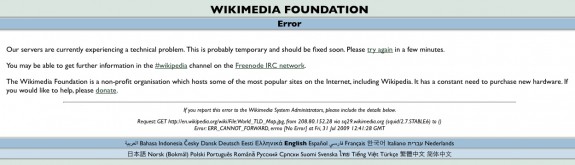
When I was just visiting Wikipedia, I was greeted with this temporary error note (which, luckily, does not happen too often in spite of Wikipedia’s huge popularity):

Wikimedia borken

And, even if this marks me as a Web 2.0 geek, I must admit: All I was thinking was — where’s the pet?

The first company to put a recognizable, even likable, “pet” onto their error pages was likely Twitter. And due to the horribly frequent outages associated with Twitter’s “growing pain”, we got to see the littlehuge fellow quite often. In the mean time, he seems to have swam away, at least I haven’t seen him in awhile. Yet, he’s not forgotten: the fail whale even has his own fanclub.
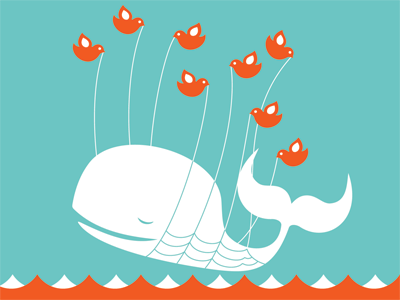
Twitter Fail Whale

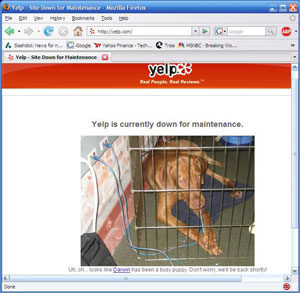
Another place where I saw a “fail pet” was yelp, whose error page was sporting a picture of an actual dog, apparently the company puppy “Darwin” (sorry for the tiny screenshot):

Yelp Puppy

Now where’s yours, Wikipedia?

Of course, considering I so provocatively ask this question, you might respond: Well, where’s yours, Mozilla?

Here at Mozilla, we are not particularly proud of software failures, because unlike your regular web 2.0 start-up (think Twitter) where every service failure means more customers than anticipated, failures in Mozilla-land usually mean a crashed browser, (possibly) lost data and certainly frowning users*). So when the Crash Reporter icon was redesigned, we could have gone ahead and hired Foxkeh as our “crash mascot”, but that would do the poor little fox wrong — and at any rate, we prefer associating mascots with good stuff here at Mozilla. So at the time, user experience engineer Alex Faaborg made sure we don’t create something too memorable, for example nothing like a second “Blue Screen of Death”. Of course, had Microsoft known at the time how appeasing error messages can become with a little help from the animal kingdom, they’d have hired the entire cast of Looney Tunes to show up in their dreaded error messages.

But this might well be one of the few things we have in common with Microsoft: No fail-pets for us, any time soon.

*) On a side note, although it won’t make a user fell better whose browser just crashed: When Firefox crashes it is most often due to binary, third-party plug-ins like Flash, Acrobat etc., and not due to a bug in Mozilla software — as evidenced by the publicly available “top crashes” list and the bugs associated with it.
User Agent Fun With Opera

When I was working with User Agent strings today, I made the unfortunate discovery that Opera claims to be MSIE (according to their knowledge base site, this is the default — or used to be, until version 8 according to this website and a friendly commenter here).

That is, of course, unpleasant, if a developer wants to display content to specific users based on their user agent. Unlike the current, ugly GeoIP epidemic (which I shall blog about another time), there are fairly good reasons for doing this — all of which are negatively impacted by claiming to be a specific browser if you are not. Let me just name three of these reasons, off the top of my head:

  1. Relevance. Some content (pictures, instructions, warnings) may simply not apply to people outside a specific user group.
  2. Workarounds. Particularly MSIE 6 was/is infamous for numerous bugs and inconsistencies, some of which can be worked around. There is little reason why anyone else would like to see these “hacks” applied to the page they are visiting.
  3. Differences in technology. Some people produce browser extensions for, for example, both Firefox and MSIE. They may want to serve appropriate instructions to these users, and maybe a third page to everyone else.

I am not only convinced some Opera users would be outraged to be served Internet-Explorer-only content. I also assume that through Opera’s claiming to be MSIE, Opera users can report numerous cases when the false user agent triggered some quirks on websites that were installed by the website author only to handle MSIE’s abundant bugs at the time. Why anyone would want this setting to be the default, I cannot understand: Claiming to “be somebody else” should be the exception, not the rule.

People have blogged before about the near-uselessness of the User Agent string (in connection with Google Chrome’s football-field-long UA string), and they have probably done a much better job than I would. From a developer perspective though, this is frustrating. So I twittered:

Uhm, why does Opera claim to be MSIE in its User Agent string?

followed by:

To be fair, only old versions of Opera do that.

and soon thereafter, I got this interesting answer from a friend:

… they were hoping to be accidentally bundled with Windows.

I must say, in the light of Opera being the initiator of the ongoing antitrust investigation of the European Commission against Microsoft, this answer does not fail to convey a faint notion of irony.

Update: Commenter Eric points out that Opera’s knowledge base article that I am citing on the top is outdated and the default user agent string used by Opera is much simpler. Well, excellent.

Update 2: Another commenter points out that Opera’s impersonating MSIE has historic reasons dating back to the pre-Firefox era. — Now that these reasons are not present anymore, the UA has been adapted.

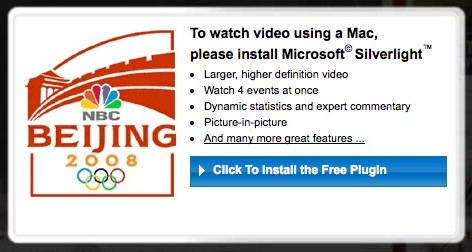
No, Thanks

Uhm, no, thanks.

(Update: A few people have wondered if I did not install Silverlight merely because it is produced by Microsoft. This is not the case, as you can read in more detail in the discussions in the comments to this article. Thanks.)

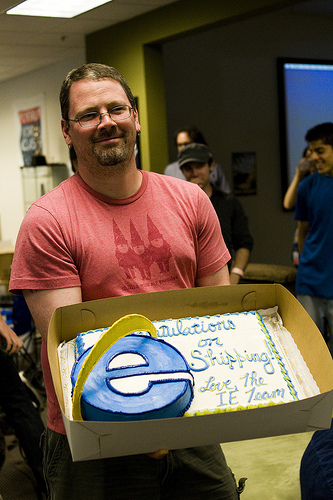
Userfriendly on the Second Microsoft Cake

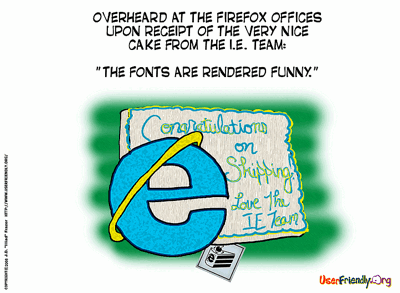
Userfriendly.org published a funny little picture about the second Microsoft cake:

They should have covered the Firefox 2 cake instead: After all, it still rendered in black and white ;)

(Thanks for the link, Jean Pierre!)