Everything but “open”

Note: Several commenters have provided valuable feedback that I am responding to with updates to this post and in the comments. Make sure to read both!


On yesterday’s WWDC keynote, Steve Jobs introduced “FaceTime” and explained its base technologies with the following words:
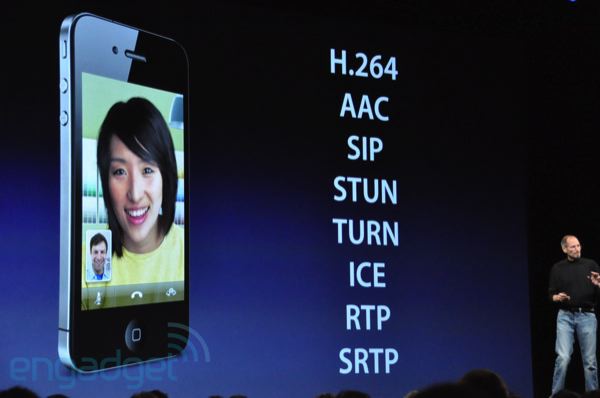
“Now it’s based on a handful of standards… but this is going to be an open industry standard.”

I wish Steve Jobs would cease calling H.264 and similar standards “open”. Technologies that cost millions of dollars to use are, by definition, not open. He can hope it’ll become an “industry standard” (as in, used by companies apart from Apple), fair enough. But he can’t say it is going to be “open”. That’s like a college kid calling the grocery store “free” just because daddy gave them an unlimited credit card. And it’s doing a huge disservice to the Open Sourcestandards community by misusing the term in the worst possible way.

Quote and photograph courtesy of Engadget. Thanks!


Update, 4/9/2010: For a while, I removed the above text in order not to express unwarranted criticism towards the speaker. After several rounds of user feedback, however, I decided to keep the original text and update/annotate this post as necessary.

Update on the definition of openness:

As Sandy pointed out in the comments, there are many definition of what standards are considered “open” and depending on which of these you follow, varying licensing fees, as long as you don’t exclude anyone with enough money to buy them, are still valid for calling a standard “open”. I disagree with that view, but it is a possible interpretation.

Commenter Dave mentions that Steve Jobs usually makes sure to call actual open standards “open” and calls H.264 and similar technologies “industry standards” instead. He is therefore likely to know the difference between the two, even though calling an entire stack “open” in spite of some of its components not matching that definition is a strange, or even misleading, point of view.

Finally, Jo argues that the mere fact that other vendors can build devices to connect to the FaceTime stack instead of it being limited to Apple products only makes it “open”. In other words, this use of “open” would be a synonym of “standards compliant”. I believe that is still a very limited view on openness, but at least it is more open than the alternative: a locked-down proprietary solution.

Peter also reminds us of the technical limitations: Since all mobile devices need hardware support for video encoding and decoding, Apple had to settle for H.264 a long time ago, and even if they wanted, they could not simply switch over to a different codec. Most people (me included) also seem to agree that H.264 is — from a purely technical standpoint — a good choice for the FaceTime stack.


14 Responses to “Everything but “open””

  1. “And it’s doing a huge disservice to the Open Source community by misusing the term in the worst possible way.”

    Open != Free

    Your linked definition is the Open Source Definition, not the definition of the word “open”. Steve did not say “open source”.

  2. That is true, but the definition of an open standard is very close to that. My point, I believe, is still valid: A standard that you can buy a license for for a bucket of money is not “open”.

  3. All right, I removed the text because depending on what definition you follow, apparently you can call the FaceTime stack “open”. Thanks for pointing this out, Sandy.

  4. i don’t see a conflict between calling “facetime” open and having to pay licenses for one of the components. it’s facetime, thats open, so that everyone – who wants to do it and has the money to do it – can adapt the standard. steve will not stand in your way.

    it’s like when i build the most amazing phone, and publish all the detailed plans for it, for my “open phone”. everyone can build it. it has an ARM-processor in it, so you have to pay license fee to ARM. nevertheless, my plans are open.

  5. “A standard that you can buy a license for for a bucket of money is not “open”.”

    Well, you’re certainly entitled to your opinion about what “open” means. But it might be informative for you to read about RAND licensing and varying definitions of terms like “open standard” and “open specification”. In many contexts, it is considered fair to charge a bucket of money for a patent license on an “open” spec/standard.

    http://en.wikipedia.org/wiki/Open_standard#Patents
    http://en.wikipedia.org/wiki/Open_specifications

    Of course, I wish circumstances were different, but I think it’s clear that “open” is still a very muddy term.

  6. “Of course, I wish circumstances were different, but I think it’s clear that “open” is still a very muddy term.”

    Yes, definitely a muddy pit I stepped straight into, sigh.

  7. Technically it is “open” but it was a disingenuous statement when faced with google providing a truly open format (webM). An open standard that uses software with financially prohibitive licensing defeats the purpose of it being an open standard. It doesn’t matter if its open if people can’t, or won’t use it.

    To be fair, no handheld device will ever be capable of encode/decode without a hardware encoder/decoder. Regardless of motivations for or against webM, apple didn’t have the time to build webm support into their chips while they already included h.264 for video recording and playback.

  8. H264 will never be a standard for the web and that’s that. Anyone that thinks or claims otherwise is either a delusional fool or has a share of the codec…

    It’s really that simple.

  9. I know that you have removed the original content, but I would like to argue why this is really an open software architecture, but I’m not focusing on H.264 only.

    I have been programming voip software for lots of years, and I can guarantee you that these is an OPEN software architecture. As usual, people are confusing OPEN with FREE (as in beer). The architecture as outlined here, is nothing special, and is basically similar what most voip systems (the one that are used by telecommunication companies, not Skype) use these days. The whole point is that you can easily (*) build a voip system (a desktop app or a mobile phone or whatever) that can interoperate with this. It’s standards compliant. And that’s the whole point – you are NOT forced to use a mobile phone from 1 manufacturer, you can choose your own (aside from restrictions that your mobile provider might impose, but that’s something else).

    Note that the use of a separate connection (over the internet) to let video stream bypass the normal phone company network, isn’t particularly new. But Apple might have problems at first, since many phone companies might not like it (I have programmed servers before that explicitly blocked this). Maybe if they hide it in a propriety SIP header instead of in the RTP body ? And the QoS might be a bit difficult to guarantee if it needs to be passed through more than 1 ISP. We”ll see.

    The only thing a bit surprising is the limited number of codecs built-in (H.264, MPEG-4, M-JPEG). It seems that Steve seems to force other manufacturers to use H.264 as a common choice – not a bad choice from a quality point of view (H.264 has a pretty good compression profile for this type of video). The point that are are other codecs -free or not- free is moot, if there are no voip clients that currently implement them. Google might be a big influence – they’re capable of pushing VP8 in their android phones. But even they might be forced to support H.264 too, to be able to inter-operate. H.264 is also found in many IMS voip systems, which is the new standard for phone companies, so I wouldn’t be surprised if they will. And maybe force Apple to support VP8 too (I hope), and the other common codecs (H.261, H.262, H.263, …).

    Note that the use of codecs for video calls has nothing to do with their use in HTML5. But smartphones will obviously share their codecs between their browsers and their phone software.

    (*) Yes, I have implemented (parts) of such a system. Really.

  10. You (and a commenter) link to Wikipedia and claim that there is still some debate over the term.

    Wikipedia has 14 definitions. 12 say “no patent fees”, 1 is a historical accident, much like someone saying that they had “Open Source” or “Free Software” years before those gained defined meanings.

    That leaves one definition, created by the patent lawyers of the telecoms standards group that developed H.264 (somewhat of a coincidence no?). If you read the statement that is quoted in full you find they are actually reacting against the attempts by various governments and standards organizations to establish “Open Standards”.

    Note that in Steve Jobs’ Thoughts on Flash he refers to HTML, CSS and Javascript as “Open Standards” repeatedly, but calls H.264 an “industry standard” instead. He knows there is a difference and doesn’t generally mess it up.

    He will do clever and misleading things e.g. saying that FaceTime could be an open standard is true just like saying HTML5 video tag is an open standard. This doesn’t mean they can’t both use proprietary video codecs (or image files etc.) and therefore make the combination non-open.

  11. Thanks to all commenters so far (keep the comments coming, if you like :) ). I think I will tomorrow (my time) blog once again and outline in more detail what the debate is here. In fact, I find the discussion I have spawned so much more interesting than Steve Jobs’ voluntary or involuntary confusion of terms.

  12. [...] Zobacz resztę artykułu: Everything but “open” | fredericiana [...]

  13. Isn’t it a bit inappropriate to delete a post about openness? It doesn’t matter if your post was right or wrong, so long as you’re receptive to feedback and update it accordingly, that in itself would be a great example of (one form of) openness.

    Anyway, I look forward to your follow up post.

  14. voracity: Thank you for your comment! You are very right, outright deleting the article was perhaps not the greatest idea, especially considering the discussion that came out of it. Apologies for that radical step :)

    Instead of a complete followup post, I therefore decided to bring back the original text basically unchanged, and added a separate update section that addresses the individual point of views brought up here.

    Thanks to everyone for chiming in!

Leave a Reply

Comments will be closed on October 6, 2010.